Distillery Equipment Construction: Stills & Ancillary Systems
A commercial distillery requires much more than a still to produce spirits efficiently. Behind every distillation run is a network of supporting equipment responsible for transferring vapor, condensing alcohol, collecting different spirit fractions, measuring alcohol volume and maintaining safe product handling.
From copper pot stills and shell-and-tube condensers to stainless steel receiving vessels, sanitary valves and transfer pipelines, each component has a specific function. Their materials, dimensions and connections must be selected according to the properties of the process materials and the operating conditions.
The construction of distillery equipment also involves considerations that are not always obvious when purchasing an individual still. Pipework must allow complete drainage, receiving tanks need suitable venting and measurement arrangements, and electrical components must be appropriate for areas where flammable alcohol vapor may be present.
Understanding how these components work together helps distillers make better equipment decisions, particularly when planning a new facility or expanding an existing production line.
Material Selection for Distillery Equipment
Copper and stainless steel are two of the most widely used materials in commercial distillery construction. They offer different advantages, and the decision between them depends on the equipment’s role, the product it handles and the required maintenance procedures.
Copper: An Important Material in Spirit Distillation
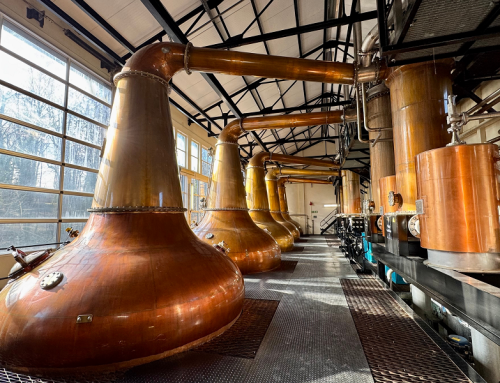
Copper has a long history in traditional pot still construction. It is commonly used for still pots, helmets, swan necks, lyne arms and other sections exposed to alcohol vapor.
One reason copper remains important in whisky and other spirit production is its interaction with sulfur-containing compounds generated during fermentation. Copper surfaces can help remove certain unwanted sulfur compounds from the vapor, influencing the aroma and character of the resulting spirit.
Copper also offers good thermal conductivity, which is beneficial in heated distillation equipment.
However, copper is not necessarily the best choice for every component. Its surface requires appropriate cleaning and maintenance, and material selection must account for the chemical conditions encountered during operation.
Stainless Steel: Durability and Hygienic Operation
Stainless steel is widely used for equipment that stores, transfers or processes fermented liquids and distilled spirits.
Its advantages include:
- Good corrosion resistance when the correct grade is selected.
- Smooth surfaces that support cleaning and hygienic operation.
- Mechanical strength and durability.
- Compatibility with many food and beverage processing applications.
- Flexible fabrication for tanks, pipelines, valves and auxiliary equipment.
Food-contact stainless steel grades such as 304 and 316L are commonly considered in distillery projects. The final selection should account for alcohol concentration, cleaning chemicals, temperature, product composition and other operating conditions.
Combining Copper and Stainless Steel
Modern distillery systems do not have to be manufactured entirely from one material.
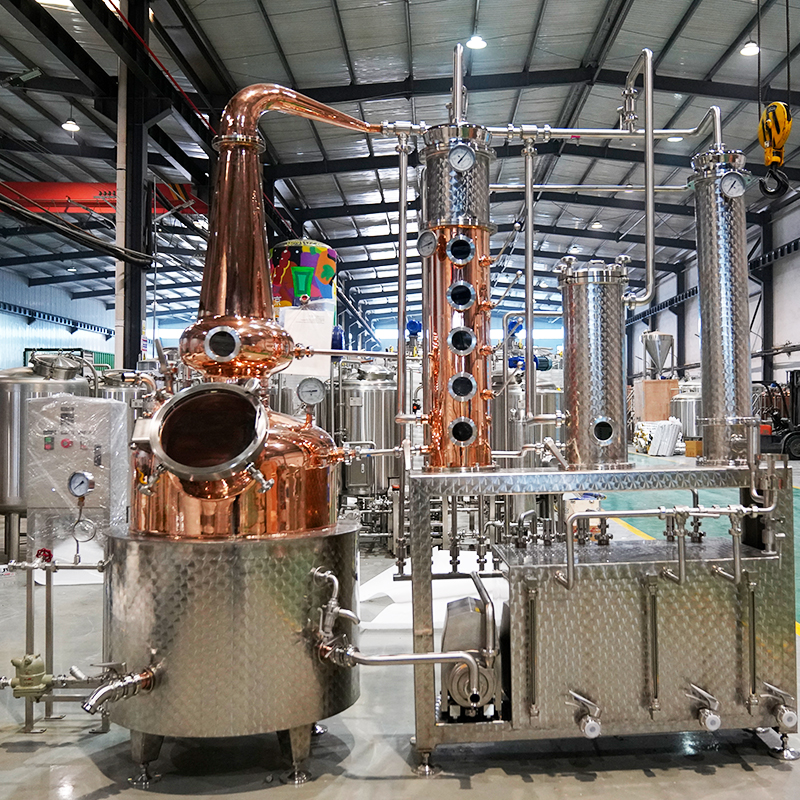
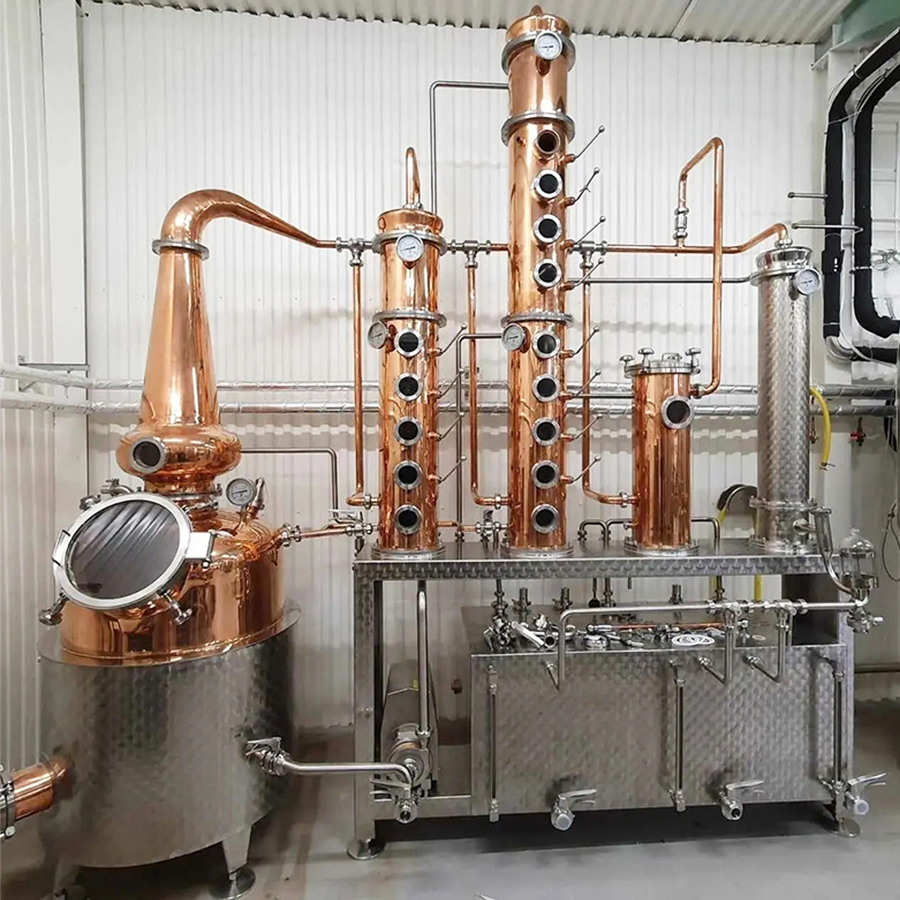
For example, a pot still may use a copper helmet and vapor-contact sections with a stainless steel supporting structure. Similarly, a condenser may combine a stainless steel outer shell with copper or stainless steel heat-transfer tubes, depending on the design requirements.
A mixed-material configuration allows the distillery to use copper where its properties are particularly useful while benefiting from stainless steel’s durability and ease of cleaning in other sections.
The objective is not to maximize the amount of copper or stainless steel, but to choose suitable materials for each component.
Construction of Stills and Condensers
The still is the central piece of distillation equipment, but its performance depends on the design of the entire vapor and condensation pathway.
Pot Still Construction
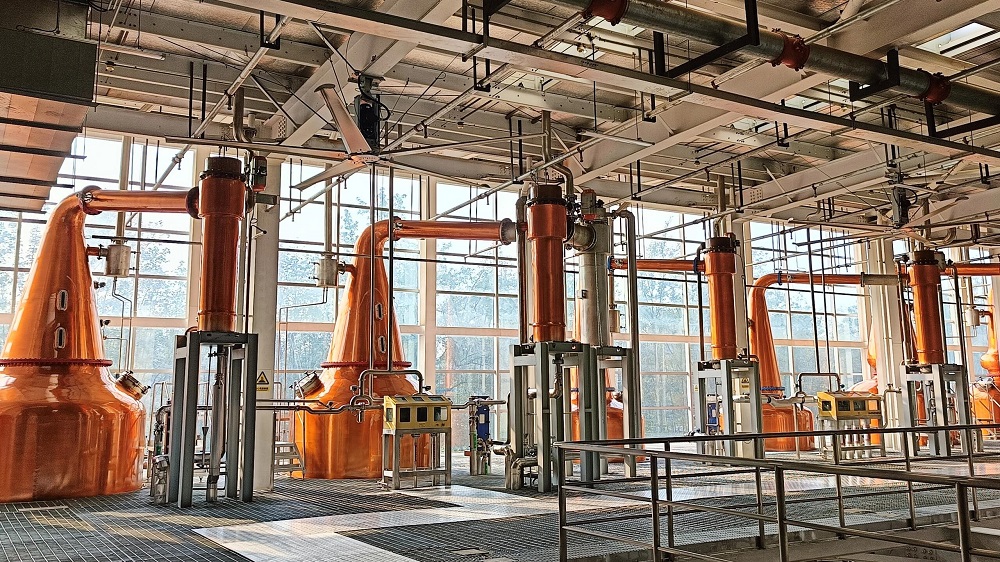
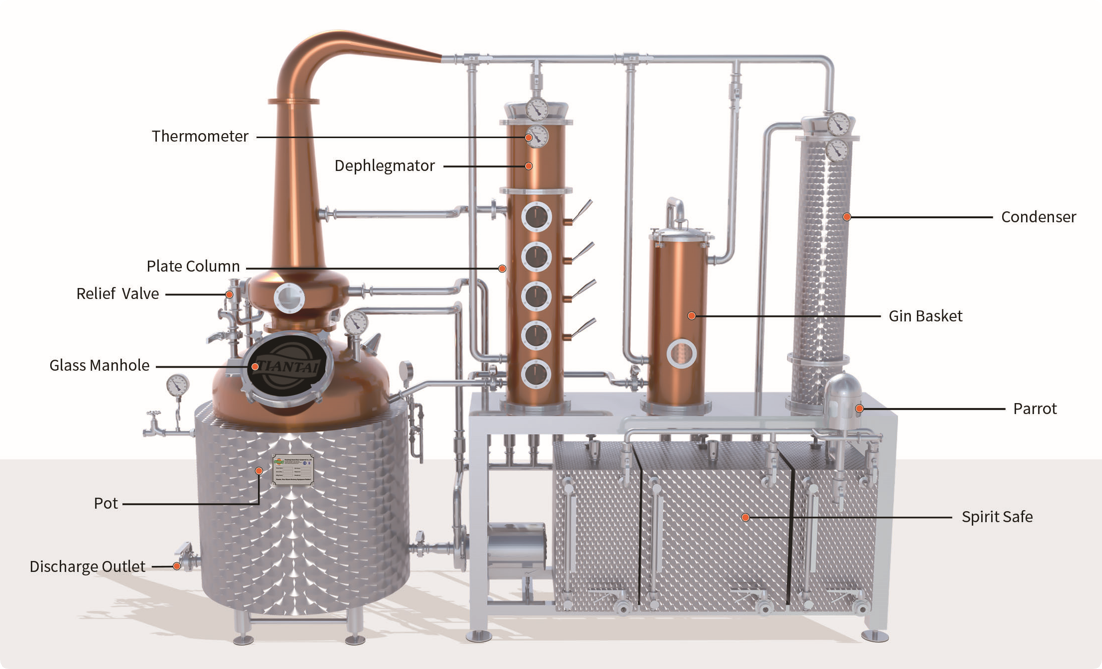
A conventional pot still consists of several interconnected sections:
- Still Pot: Holds the fermented wash or intermediate spirit before heating.
- Helmet: Collects rising alcohol vapor and directs it toward the vapor outlet.
- Swan Neck: Connects the helmet to the lyne arm.
- Lyne Arm: Carries vapor from the still toward the condenser. Its slope and configuration influence vapor movement and reflux behavior.
- Condenser: Cools the vapor and converts it back into liquid distillate.
Each section contributes to the operating characteristics of the still.
For example, the shape and volume of the helmet, the angle of the lyne arm and the arrangement of the vapor pathway can influence reflux and the composition of the distillate.
The still’s structural design must also accommodate its heating arrangement, working volume, internal pressure conditions, cleaning access and support requirements.
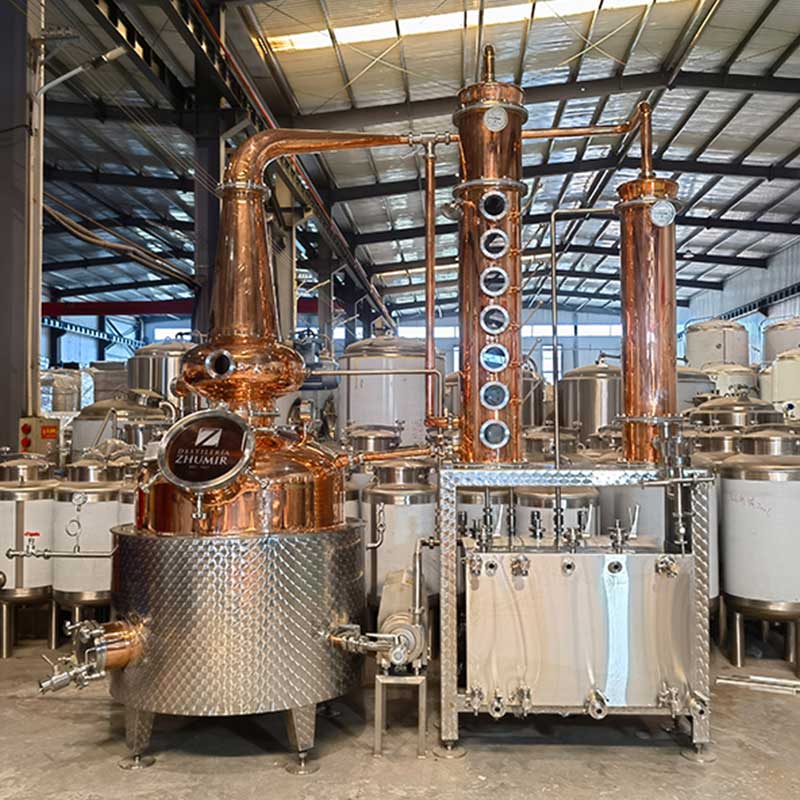
For commercial whisky, brandy and rum production, copper pot stills remain an important equipment choice. Hybrid stills and column stills may also be selected when the production process requires greater flexibility in alcohol concentration and separation.
Condenser Construction and Material Selection
After leaving the still, alcohol vapor enters the condenser, where heat is transferred to a cooling medium, usually water.
Two common condenser arrangements are shell-and-tube condensers and traditional worm condensers.
A shell-and-tube condenser contains a bundle of heat-transfer tubes enclosed within an outer shell. Vapor and cooling water pass through separate flow paths, allowing heat to transfer across the tube walls.
A traditional worm condenser uses a coiled pipe immersed in a cooling-water tank. Vapor passes through the coil and gradually condenses as heat is removed.
The choice between these designs depends on the still configuration, required condensation capacity, available cooling water and production conditions.
When designing a condenser, several factors need to be considered:
- Maximum vapor generation rate from the still.
- Required cooling-water flow and inlet temperature.
- Heat-transfer surface area.
- Condenser outlet temperature.
- Pressure drop through the vapor pathway.
- Ease of cleaning, inspection and maintenance.
An undersized condenser may fail to fully condense the vapor during peak operation, while an unnecessarily large unit can increase equipment and utility costs.
The condenser should therefore be designed to match the actual still capacity and operating conditions rather than selected independently.
Spirit Receivers and Collection Vessels
After condensation, the distillate must be collected in vessels designed for its intended purpose.
A distillery may need several types of receiving tanks depending on its production method. These can include wash charging vessels, low wines receivers, foreshots receivers, intermediate spirit receivers and feints receivers.
Although they may appear similar externally, their working capacities, connections and operational requirements can differ.
Different Receivers for Different Stages
Wash Charging Tanks
These vessels hold fermented wash before it is transferred into the still. Their capacity should correspond to the working volume of the still and the distillery’s batch schedule.
Low Wines Receivers
Low wines receivers collect the lower-strength distillate from the first distillation run. Their capacity should accommodate the expected output without interrupting the production process.
Foreshots and Feints Receivers
During spirit distillation, the initial and final fractions are separated from the desired middle cut. Dedicated receivers allow these fractions to be collected and handled independently.
Depending on the distillery’s production process, these fractions may be stored separately for later redistillation or other approved process uses.
Intermediate Spirit Receivers
These vessels collect selected spirit fractions before subsequent processing, blending or transfer to maturation storage.
Separating collection vessels according to their function helps operators manage the distillation process and maintain traceability between batches.
Why Stainless Steel Is Commonly Used
Stainless steel is a practical choice for modern spirit receivers because of its durability, cleanability and suitability for handling alcoholic liquids.
Receiver construction may include:
- Suitable product-contact stainless steel surfaces.
- Filling and discharge connections.
- Sampling points.
- Level or volume measurement devices.
- Appropriate venting arrangements.
- Cleaning connections and accessible inspection openings.
For vessels used in excise-controlled operations, measurement arrangements may also need to meet local tax and legal metrology requirements.
Depending on the facility, these may include calibrated volume tables, dipsticks, level measurement systems or other approved gauging methods.
The vessel design should make it possible to measure and account for the spirit accurately while protecting the contents against unauthorized access or unintended transfer.
Valves, Pipework and Transfer Connections
Pipelines connect the still, condenser, collection vessels and storage tanks into one operating system.
Their design influences transfer efficiency, cleaning requirements, product losses and the ease of operating the distillery.
Selecting Suitable Valves
Different valve designs serve different purposes in a distillery.
Ball Valves: Commonly used for product transfer and isolation because they offer straightforward operation and relatively low flow resistance.
Butterfly Valves: Often used on larger process lines where compact construction and quick operation are important.
Diaphragm Valves: Useful in applications requiring hygienic flow control and reduced product retention around the valve mechanism.
Gate Valves: May be used in selected utility or process isolation applications, depending on the service requirements.
The valve body, internal components, and sealing elements must be suitable for the liquid or vapor passing through them.
Alcohol-resistant, food-compatible gaskets and seals are particularly important. Check their compatibility against alcohol concentration, operating temperature, and cleaning chemicals.
For vessels subject to excise controls, locking provisions may also be required on selected valves or transfer connections according to local regulations.
Pipe Diameter and Layout
Pipe diameter should be determined from the required flow rate, fluid properties, pressure conditions and equipment connection sizes.
A transfer line carrying liquid spirit has different design requirements from a vapor line connecting a pot still to a condenser.
Using an unsuitable pipe diameter may lead to excessive pressure loss, poor flow conditions or difficulties during operation.
The pipe layout is equally important.
Dead legs, unnecessary bends and low points where liquid can remain trapped should be minimized. Where appropriate, pipelines should be installed with a suitable slope toward designated drainage or receiving points.
This helps ensure that residual liquid can be removed after transfer, reducing product losses and making cleaning more effective.
Flanged connections, welded joints and other fittings should also be selected according to the operating conditions. Where flanges are used, sealing materials must be compatible with the alcohol concentration and process temperature.
Good pipework design should also allow access for valve operation, inspection, maintenance and future equipment connections.
Spirit Safes, Measurement and Process Control
In traditional pot still distilleries, the spirit safe is an important part of the spirit collection and control arrangement.
It provides a secure location where operators can observe, measure and direct the distillate without handling the spirit directly during the separation process.
Traditional spirit safes are often constructed from brass and fitted with viewing windows. They may incorporate measuring instruments, sampling points, valves and locking arrangements.
The operator can observe changes in the distillate and direct the appropriate fractions to their designated receiving vessels.
Although modern distilleries may use additional electronic measurement and automated control systems, the underlying requirements remain similar:
- Accurate alcohol strength measurement.
- Reliable fraction separation.
- Secure access to controlled spirit flows.
- Clear identification of receiving vessels.
- Consistent recording of production volumes.
The appropriate arrangement depends on the distillery’s production method and the level of manual or automated operation required.
Venting and Safety in Alcohol Handling Systems
Safety is an essential part of distillery equipment construction, particularly where high-strength alcohol and flammable vapor are handled.
During distillation, alcohol vapor passes through the still, condenser and associated pipework. Receiving vessels and storage tanks may also release alcohol vapor during filling, emptying or changes in liquid level.
These conditions require suitable equipment design and appropriate safety measures.
Tank Venting and Flame Protection
Spirit receivers and charging vessels should have venting arrangements designed for their operating conditions.
Vents must discharge to an appropriately assessed safe location, with consideration given to vapor release, ventilation and the potential presence of ignition sources.
Flame arresters may be specified where required by the equipment design and applicable safety regulations. They must be selected for the relevant vapor service and installed and maintained correctly.
It is also important not to treat a flame arrester as a replacement for pressure and vacuum protection. Tanks and process vessels require suitable protection against excessive pressure or vacuum according to their design conditions.
Electrical Equipment in Distillery Areas
Areas where flammable alcohol vapor may be present require particular attention to electrical equipment.
Motors, switches, control panels, instruments, lighting and wiring must be selected according to the hazardous-area classification and applicable local regulations.
Depending on the project location, relevant requirements may include ATEX or IECEx frameworks and associated installation standards.
The electrical and mechanical design should be considered together with ventilation, grounding and bonding, vapor control and fire protection measures.
Safety provisions should be established during the initial engineering stage rather than added after the equipment layout has been finalized.
Cleaning, Drainage and Long-Term Maintenance
A well-designed distillery should be easy to clean, inspect and maintain.
Residual wash, spirit and cleaning solutions can remain inside poorly designed vessels or pipelines. Over time, inaccessible product residues may create hygiene problems and make batch changeovers more difficult.
Several construction details can improve maintainability.
Drainable Vessel Design: Tank bottoms and outlet connections should allow the contents to be removed effectively, with attention to the actual installation level and outlet arrangement.
Accessible Connections: Manways, inspection ports, valves and removable components should be positioned to allow routine inspection and maintenance.
CIP Compatibility: Where clean-in-place systems are used, spray devices, pipeline routing and cleaning return connections should be designed to provide effective coverage.
Avoiding Liquid Retention: Proper pipe slopes and minimized dead legs reduce the possibility of product remaining trapped in the system.
Maintenance Planning: Seals, gaskets, valves, instruments and safety devices should be accessible for inspection and replacement.
These considerations become especially important in commercial distilleries running several production batches each week. Equipment that is difficult to clean or maintain can gradually reduce production availability and increase operating costs.
Designing a Complete Distillery Equipment System
The construction of a successful distillery requires more than selecting individual pieces of equipment. The still, condenser, receiving vessels, transfer lines and supporting systems must work together as one production arrangement.
Before manufacturing begins, several project requirements should be established:
- Type of spirit to be produced, such as whisky, gin, rum, vodka or brandy.
- Required batch capacity and expected production frequency.
- Still type and distillation configuration.
- Heating method and available utility supply.
- Condenser capacity and cooling-water requirements.
- Number and working volume of spirit receiving vessels.
- Manual or automated fraction collection requirements.
- Cleaning, drainage and maintenance arrangements.
- Local safety, electrical and regulatory requirements.
These details influence not only the equipment specifications but also the overall plant layout and connection arrangement.
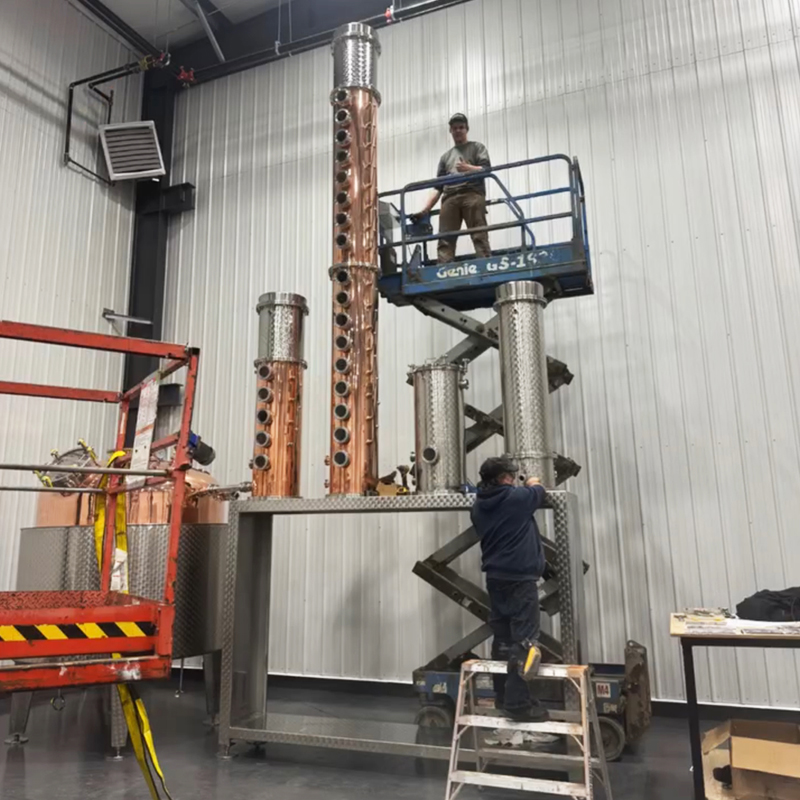
At Tiantai, distillery projects combine copper and food-grade stainless steel equipment with customized process configurations. Pot stills, hybrid stills and column stills can be integrated with condensers, fermentation vessels, spirit receivers and other supporting equipment according to the intended production process.
For projects in the 100L–8,000L per-batch range, equipment planning can cover the complete arrangement, from individual vessel dimensions and connection positions to utility requirements and production workflow.
Tiantai provides equipment design, manufacturing, factory testing, layout planning, installation and commissioning support. Coordinating these elements from the beginning helps ensure that the selected still capacity, auxiliary vessels and transfer systems are compatible with the intended production schedule.
Conclusion
Distillery equipment construction involves much more than fabricating a copper still or assembling a collection of stainless steel tanks. Material selection, condenser performance, receiving vessel capacity, valve configuration, pipeline drainage and safety provisions all influence the reliability of the complete production system.
A well-designed distillery integrates these components around the actual distillation process. This makes equipment easier to operate, clean and maintain while supporting accurate spirit collection and consistent production.
Whether establishing a small craft distillery or expanding a commercial production facility, considering the auxiliary equipment alongside the still itself is essential to achieving a practical and reliable installation.
Planning a new distillery or upgrading your existing equipment? Contact Tiantai to discuss your spirit type, production capacity and equipment requirements. Our team can help develop a customized distillery system integrating stills, condensers, spirit receivers and supporting process equipment.