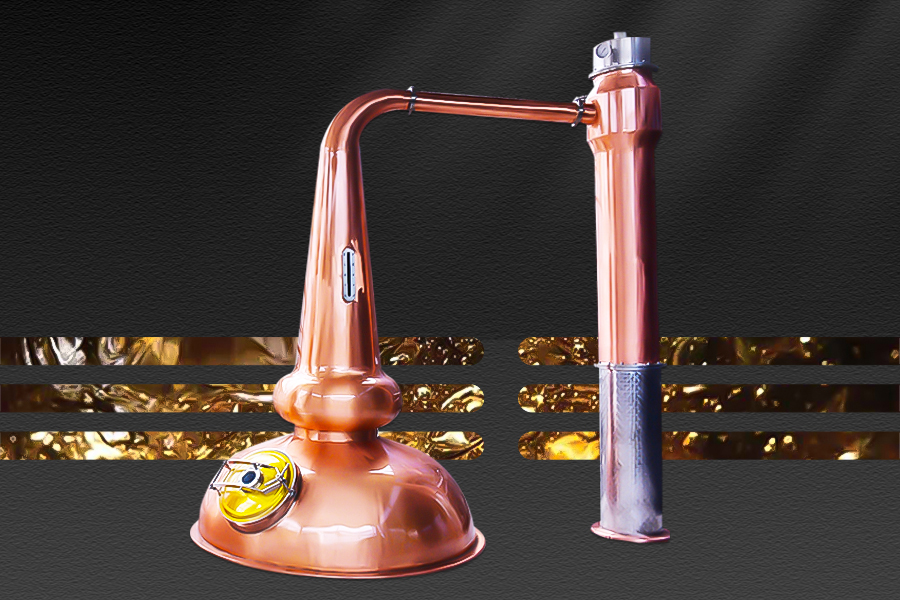
Understanding Pot Still Distillation
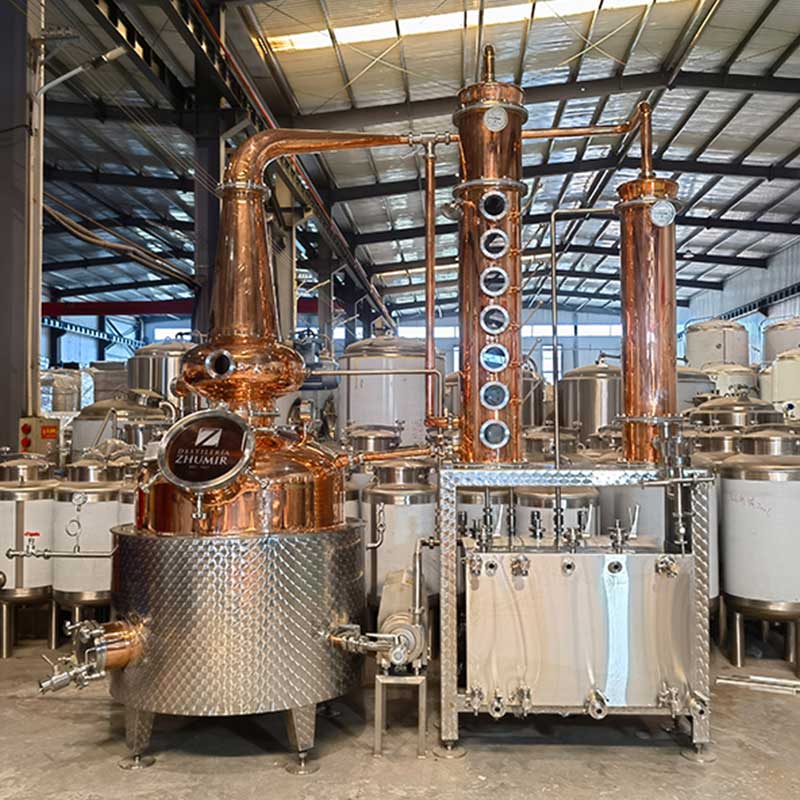
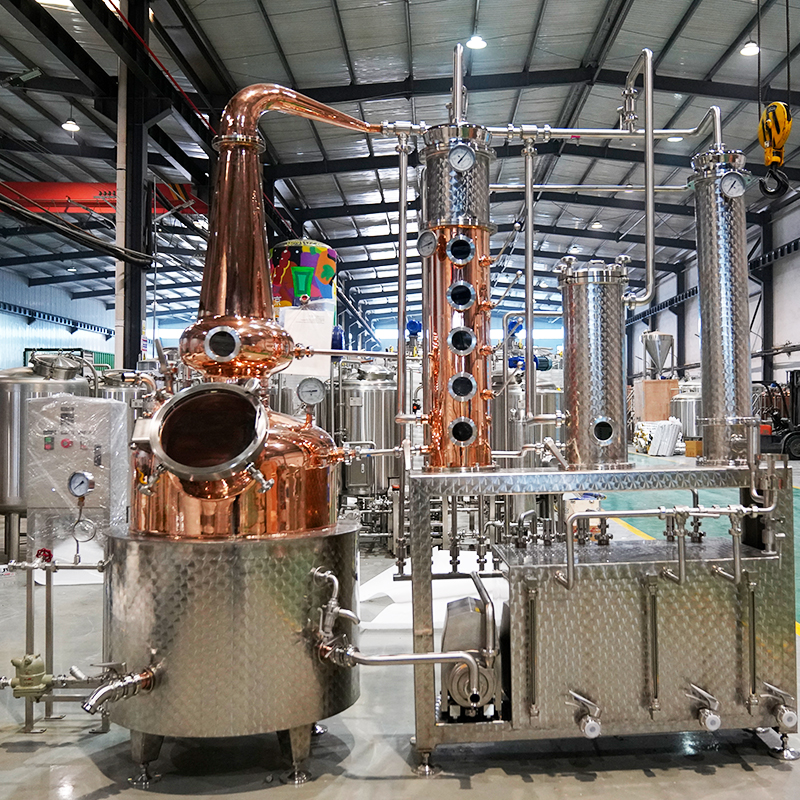
The basic flow of pot distillation is as follows: a copper distillation kettle is charged with fermented wash and heated to boiling by a heat source; volatile components travel with the vapour along the swan neck and lyne arm to the condenser, where phase-change cooling yields the distillate. When most project owners select equipment, their focus is concentrated on the explicit geometric parameters — swan neck height, lyne arm angle, and condenser configuration — and they understand the role of natural reflux in shaping spirit character. Yet in the scaled-up commercial production of medium-size distilleries, the pain points of batch-to-batch flavour drift, process-scale-up inaccuracy, and the irreproducibility of pilot parameters often arise from causes beyond reflux.
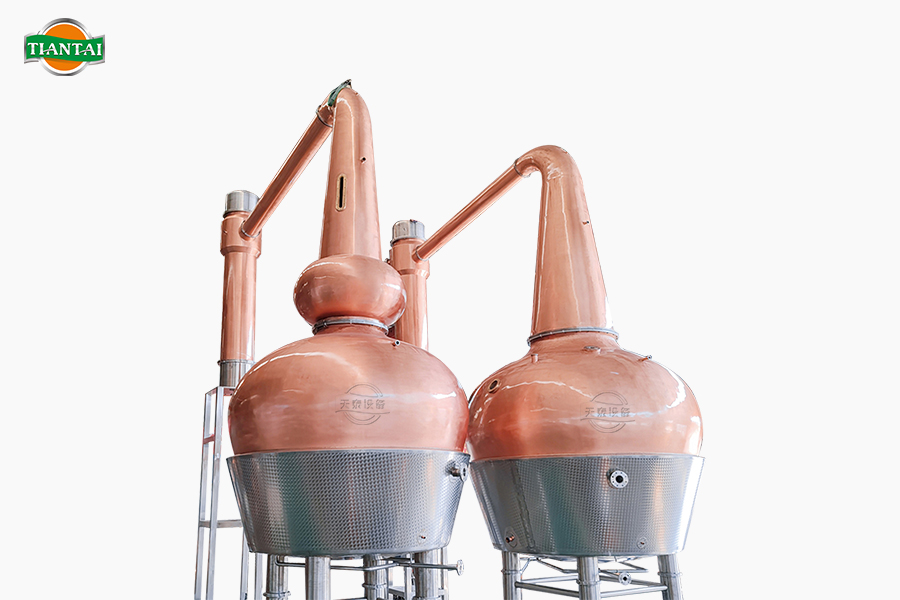
Reflux
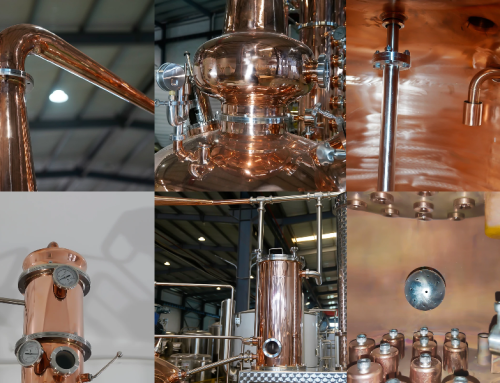
Reflux is the fundamental vapour-phase selective mass-transfer mechanism in pot distillation. As vapour rises, the cool copper inner wall induces high-boiling congeners to condense and fall back into the pot, while light aroma components continue migrating toward the condenser; the repeated contact between the two phases achieves component separation. Reflux is governed jointly by the above-kettle geometry, the internal fittings of the helmet, and system heat loss. In a basic still without a helmet, reflux is relatively low: substantial heavy congeners distil over with the ethanol, yielding a full-bodied, pungent new-make spirit that typically requires lengthy maturation in oak casks to soften. With an optimised reflux helmet (Whisky Helmet) fitted, reflux can be significantly enhanced, giving a cleaner distillate with more refined fruit and floral notes.
Swan neck height and lyne arm angle are the primary adjustable means of framing the basic flavour profile. The higher the swan neck, the more complete the reflux and the lighter, purer the spirit. An upward-angled lyne arm enhances natural reflux, producing a light, clean spirit; a downward-angled lyne arm suppresses reflux, enriching heavy components and yielding an oily, full-bodied spirit. Condenser configuration — worm-tub versus shell-and-tube — differs significantly in copper contact area and heat-exchange load, directly affecting sulphur-compound removal efficiency and establishing the basic flavour character of the new-make spirit. For this reason, equipment selection cannot rely on comparing nominal volume alone; the entire vapour-flow path must be matched to the target spirit style from the outset.
Copper
Copper is not merely a pressure-bearing, corrosion-resistant shell; it is an interfacial catalytic reaction carrier — a trait that distinguishes pot distillation from column rectification. Sulphur-bearing off-flavour compounds in the vapour, such as thiols and dimethyl trisulfide, react at the active copper interface to form compounds such as copper sulphide, which are removed during cleaning; simultaneously, the copper surface promotes the formation of esters, underpinning the fruit and floral profile. The desulphurisation and esterification activity of copper depends on surface-condition regime, not on copper plate thickness.
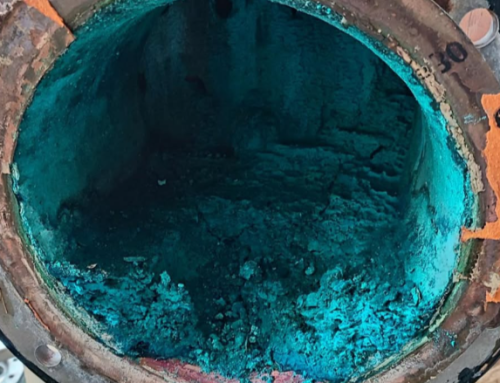
New copper exhibits an activation transition period: desulphurisation activity is high while esterification remains weak. After stable operation, a thin, uniform reactive film forms — the optimal steady-state regime. Over prolonged service, scale and carbonised deposits cover the active copper surface, blocking the mass-transfer interface; thermal decomposition of these deposits may also release burnt, harsh off-notes. Copper is a consumable functional material whose wall thickness gradually decays under cyclic heat load and acidic vapour conditions. Tiantai’s standard configuration therefore employs forged copper plate with lead-free food-grade solder, fitted with detachable internal components and quick-opening inspection ports, and provides dedicated cleaning and maintenance protocols matched to raw-material sulphur load and solids content, so as to stably sustain copper interfacial reactivity.
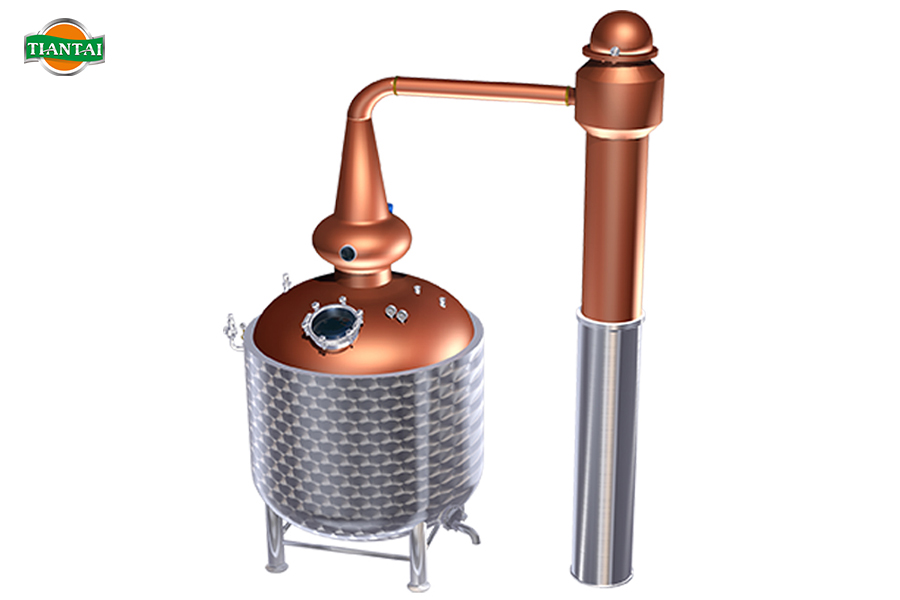
Mainstream Process Route: Double Batch Distillation
Mainstream premium spirits are typically produced by double batch distillation: the wash still concentrates the fermented wash into low wines, which are then transferred to the spirit still for the second distillation, yielding a new-make spirit of approximately 60%–70% vol. The distiller precisely cuts fractions — discarding the heads and retaining the hearts while truncating the tails; heads and tails are combined and redistilled to recover alcohol and improve raw-material utilisation. The mission of the equipment is to deliver a stable, repeatable mass-transfer operating condition so that the distiller’s sensory experience and cut standards can be continuously consolidated and stabilised. Equipment cannot replace the distiller’s sensory judgment, but a distillation system designed through flow-field simulation and raw-material adaptation can lock the vapour path, reflux intensity, and heating curve within a preset process window. Once the equipment’s fluctuation exceeds the process tolerance, a stable, consistent product style is unattainable.
This is the defining attribute of commercial pot-still equipment: it is not a universal pressure vessel but a complete process system solidified in metal structure. The kettle body profile, neck geometry, copper contact interface, heat exchange, and venting scheme — every structural change perturbs the mass-transfer boundary, reflux intensity, and interfacial catalytic reactions, ultimately manifesting in the flavour profile of the finished spirit.
Tiantai is a specialised supplier in the field of food fermentation and distillation equipment, holding D1/D2 pressure-vessel qualification, with end-to-end capabilities spanning flow-field simulation, structural customisation, automation integration, and turnkey plant delivery, serving a range of craft distillery projects producing malt whisky, pomace brandy, gin, and rum. For both greenfield distilleries and upgrades to existing production lines, we customise complete distillation systems oriented to target flavour, matched to raw-material characteristics, capacity planning, and maturation routes.