Gin for Micro Distilleries
For a new micro-distillery, choosing the right spirit to produce is not only a matter of taste. It is also a question of capital investment, production flexibility, inventory turnover, and how quickly a new product can reach the market.
Gin is often a practical starting point for a small commercial distillery. Unlike spirits whose commercial value depends heavily on long-term barrel maturation, gin generally does not require years of ageing before sale. A distillery can develop a distinctive botanical profile, produce relatively small batches, evaluate customer response, and adjust the next recipe without committing large amounts of capital to long-term inventory.
Gin also gives smaller producers considerable room for differentiation. Juniper provides the characteristic foundation, while citrus peels, coriander, roots, herbs, flowers, spices, and other botanicals can be combined in different ways to create a distinctive house style.
For a micro-distillery, this combination of relatively fast product turnover and recipe flexibility makes gin an attractive category. The key is to build a gin distillery system that provides enough control and flexibility for both initial production and future product development.
Tiantai designs and manufactures commercial distillation equipment for projects ranging from small and micro distilleries to larger spirits production plants. For gin projects, the equipment can be configured around the customer’s botanical recipe, distillation method, batch capacity, and future expansion plans rather than forcing every producer into one standard still configuration.
Why Gin Fits the Micro-Distillery Model
The economics of a small distillery are very different from those of a large spirits producer.
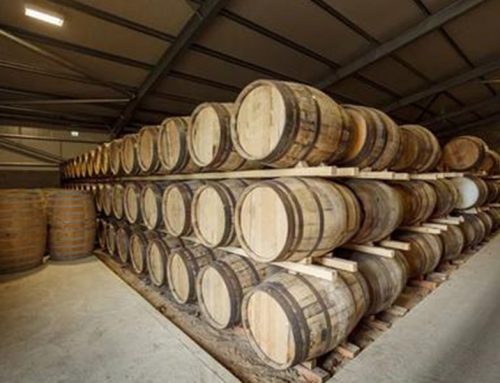
A whisky or other aged spirit may require substantial working capital to remain tied up in barrels while the product matures. During this period, the distillery has already paid for raw materials, production, barrels, storage, and handling, while the finished product remains outside the immediate sales cycle.
Gin operates differently.
Once the neutral spirit has been prepared, the distillery can process the spirit with its selected botanicals, complete the required distillation and finishing stages, and move the product toward packaging without waiting for an extended maturation period.
This creates a much shorter product-development cycle.
A small distillery can also build several gin expressions from a similar production platform. A classic juniper-forward gin, a citrus-led gin, a floral expression, and a contemporary herbal recipe may all use the same core distillation system while relying on different botanical combinations and process settings.
For a new producer, this makes equipment flexibility particularly important.
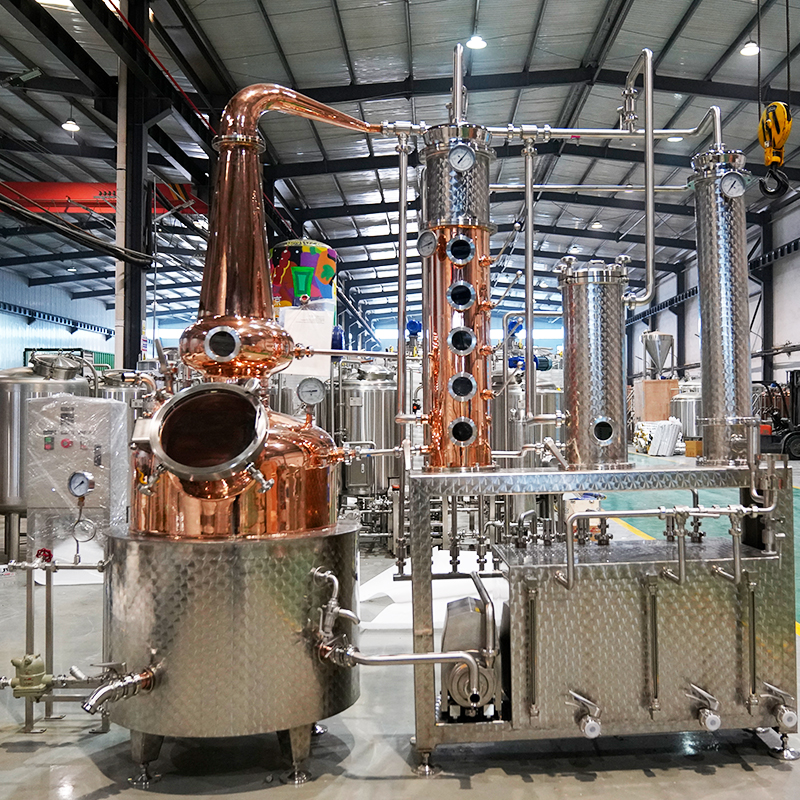
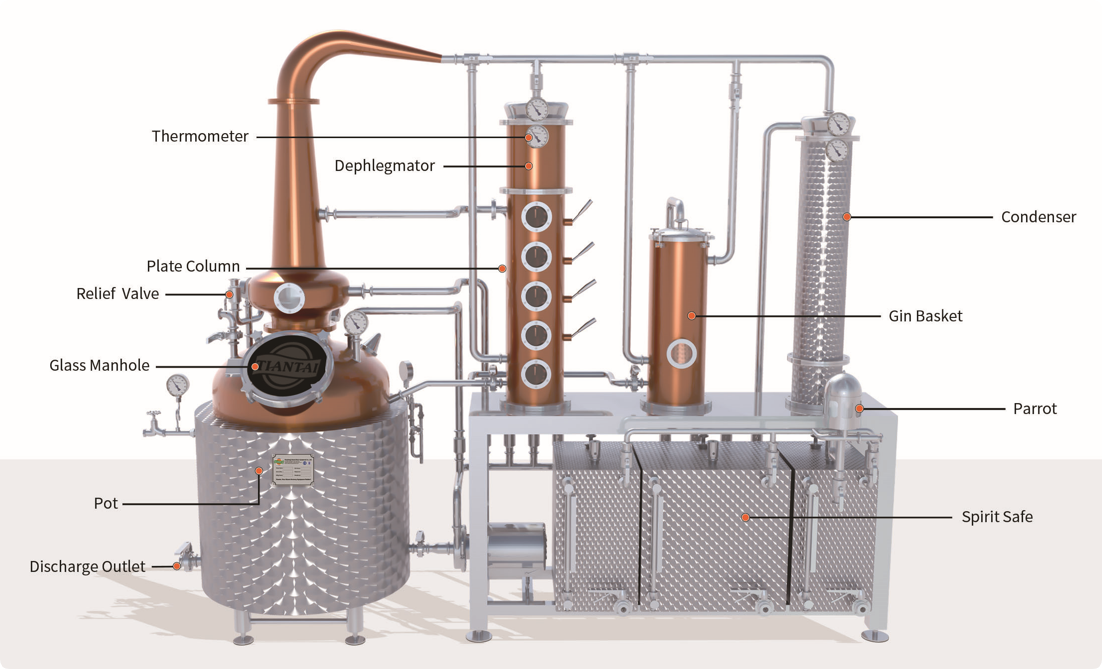
Tiantai approaches gin equipment as a process system rather than simply a distillation vessel. The still, botanical basket, condenser, spirit tanks, water treatment, filtration, CIP, and filling equipment can be selected and integrated according to the intended production process. This allows a micro-distillery to start with one or two core products while retaining room for additional recipes and spirit categories later.
Gin Production Process
The exact configuration depends on the gin type, botanical recipe, and production philosophy.
1. Neutral Spirit as the Base
Gin is generally produced from a high-purity neutral spirit, often referred to as Neutral Grain Spirit (NGS) when it is produced from grain.
Some micro-distilleries purchase suitable neutral spirit and concentrate their own production on botanical distillation and product finishing. Others produce the neutral spirit themselves as part of a complete grain-to-glass distillery.
Where NGS is produced in-house, the upstream process can include grain handling, milling, mashing, fermentation, distillation, and rectification before the neutral spirit enters the gin production stage.
This distinction is important when planning a new distillery.
A gin-only producer may prefer a relatively compact system centered on gin distillation, while a producer planning to manufacture its own neutral grain spirit may require a much more comprehensive upstream process.
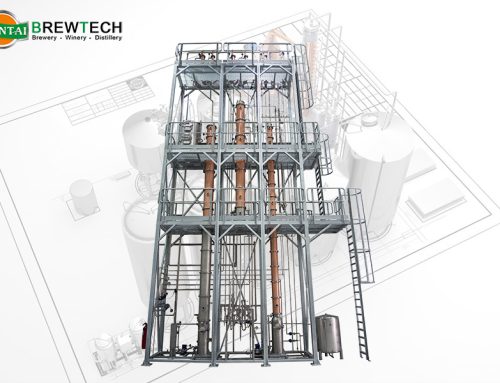
Tiantai can configure either approach. A project can be developed around a purchased neutral spirit, or the distillery can be designed as an integrated system covering raw material preparation, fermentation, distillation, rectification, gin redistillation, storage, and packaging.
2. Botanical Preparation
Botanicals determine much of a gin’s character.
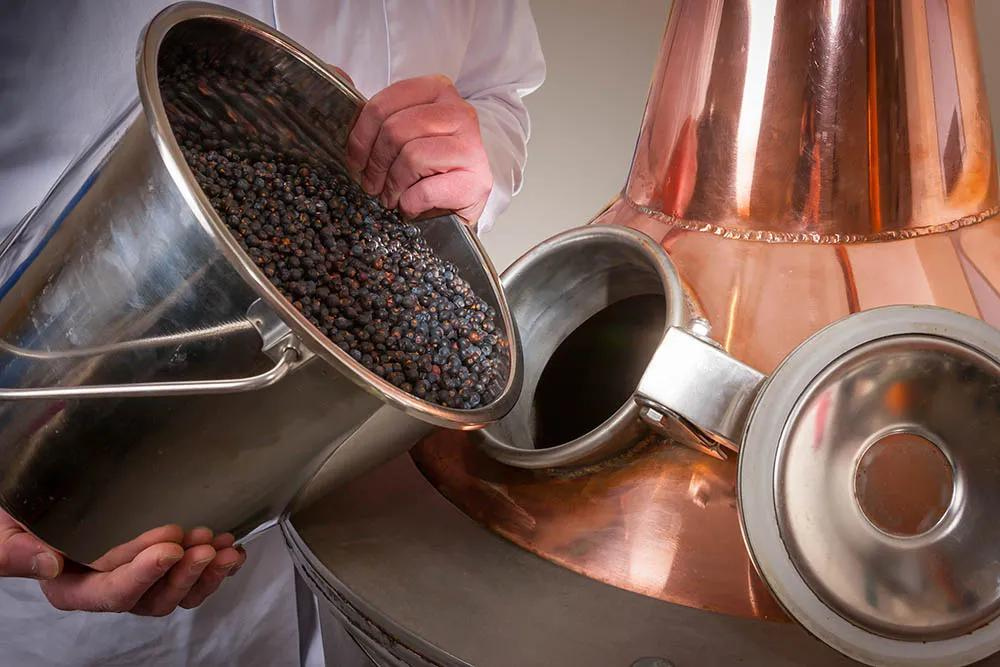
Juniper usually forms the foundation, while other ingredients provide citrus, floral, spicy, earthy, herbal, or aromatic notes.
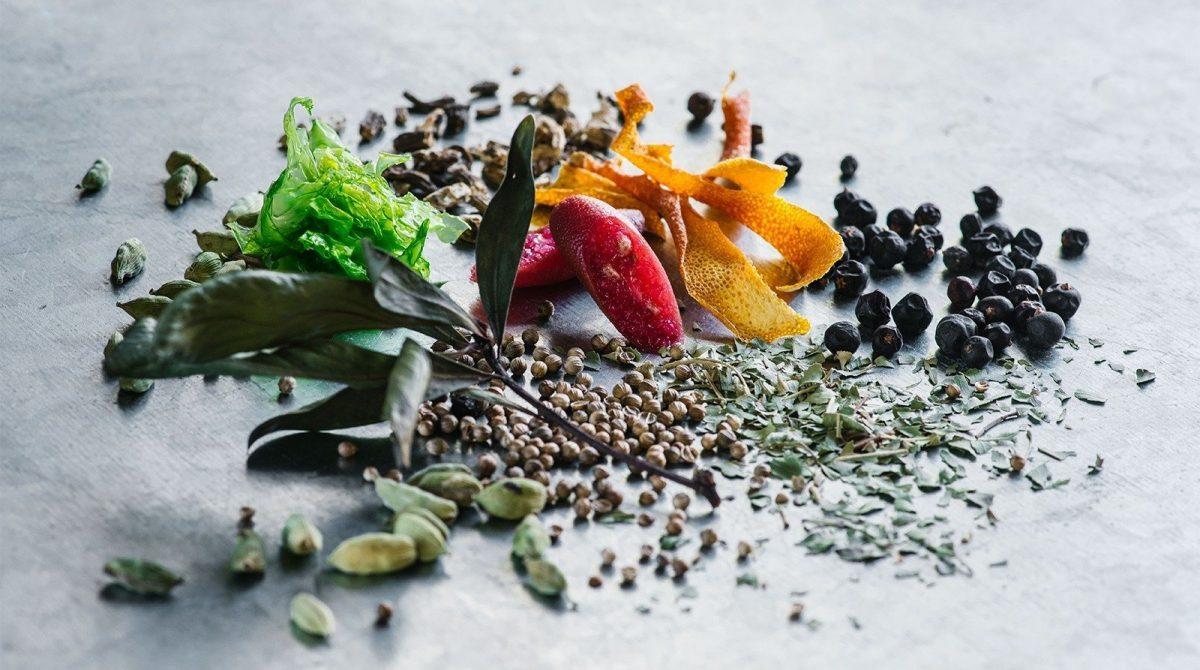
Common botanical categories include:
- Juniper berries
- Coriander seed
- Citrus peel
- Roots and rhizomes
- Herbs and leaves
- Flowers
- Spices
- Seeds and other aromatic ingredients
Different materials also require different handling.
Some dried botanicals may be crushed or prepared before use to improve contact with the spirit. Others need gentler treatment to preserve delicate aromatic compounds.
For this reason, a commercial gin plant should consider botanical handling as part of the overall process design, rather than treating the botanical stage as a small accessory to the still.
Tiantai can integrate botanical loading and infusion arrangements into the distillation system according to the selected recipe and extraction method. This is especially useful for micro-distilleries that intend to test multiple botanical formulations during product development.
3. Maceration and Botanical Extraction
One common approach is to place selected botanicals directly into the spirit before distillation.
During maceration, alcohol extracts soluble aromatic compounds from the botanical material. Extraction behavior depends on factors including alcohol concentration, contact time, temperature, botanical composition, and particle size.
Not every botanical needs to be handled in the same manner.
Some ingredients are well suited to direct maceration, while delicate aromatic materials may be better introduced through vapor infusion. A commercial gin distillery therefore benefits from a system that allows the producer to adjust the botanical-contact method rather than locking the plant into one process.
Tiantai gin stills can be configured with different botanical treatment arrangements, allowing the equipment to be adapted to the formulation instead of requiring the recipe to be adapted to a fixed machine design.
4. Vapor Infusion and Botanical Basket
Vapor infusion is another important approach to gin production.
In this configuration, selected botanicals are placed in a basket or dedicated chamber above or within the vapor path. As alcohol vapor passes through the botanicals, it extracts and carries their aromatic compounds into the condenser.
Vapor infusion is particularly useful when the distiller wants to preserve lighter and more delicate aromas.
A gin still supplied by Tiantai can incorporate a botanical basket or vapor infusion section as required by the process. The size, position, material handling arrangement, and connection to the still can be considered together with the intended botanical load and production capacity.
This kind of configuration is valuable for micro-distilleries because recipe development is often still underway during the early stage of the business.
A flexible botanical system makes it easier to move from a pilot recipe to regular production without replacing the core still.
5. Gin Distillation
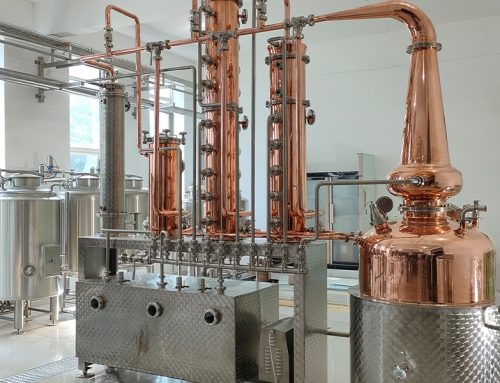
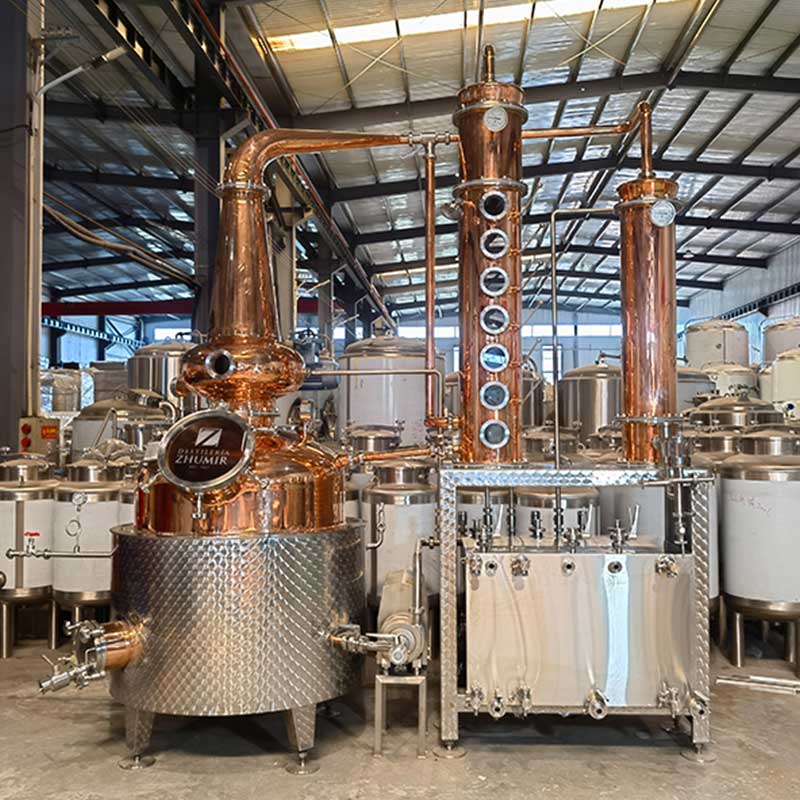
The distillation still is the central piece of a commercial gin production system.
During distillation, alcohol vapor and aromatic compounds move through the still and are subsequently condensed into liquid spirit. Still design influences the degree of rectification, copper contact, vapor movement, and botanical extraction.
Depending on the product and process, a gin distillery may use a pot still, a still combined with a rectification section, or a configuration incorporating additional separation components.
Important equipment considerations include:
- Still volume and working capacity
- Heating system
- Column or rectification section
- Botanical basket
- Condenser
- Temperature measurement and control
- Spirit collection
- CIP and drainage
- Material and surface finish
Tiantai’s distillation systems are manufactured in stainless steel as the primary process material, with copper components available where copper contact is required by the distillation process and product design.
The equipment can also be engineered around the intended heating method, operating conditions, batch size, and plant utilities.
This is particularly important for micro-distilleries because the best still is not necessarily the largest one. A correctly sized and properly configured system can provide better control over small commercial batches while leaving room for production expansion.
6. Heads, Hearts and Tails Management
Spirit collection is another area where process control matters.
During distillation, the distiller separates different fractions according to the characteristics of the spirit. The desirable heart fraction is collected for the finished gin, while other fractions can be handled separately for redistillation or disposal depending on the process.
Tiantai can provide spirit collection and storage arrangements designed to support controlled fraction handling, allowing the operator to manage collected spirit through dedicated tanks and valves.
For a commercial distillery, this is more practical than relying on improvised containers and manual transfers, particularly when production volumes increase.
7. Proofing and Blending
After distillation, the gin is normally adjusted to its intended bottling strength using suitable water.
Water quality is important because the addition of water can influence clarity, mouthfeel, and the final sensory balance of the spirit.
A commercial gin system may therefore include treated-water preparation, blending tanks, transfer pumps, and measurement or control equipment.
Tiantai can integrate water treatment, spirit blending, and storage tanks into the wider distillery system so that final proofing becomes a controlled production step rather than a separate manual operation.
Where a distillery produces several gin expressions, dedicated or appropriately managed tanks can also simplify recipe separation and batch tracking.
8. Filtration and Final Treatment
Filtration is selected according to the product and process requirements.
Some gin products benefit from final filtration to improve clarity or remove particulate material, while excessive filtration may remove desirable aromatic or textural characteristics.
For commercial production, the filtration system should therefore be chosen in relation to the botanical recipe and final product specification.
Tiantai can integrate suitable filtration equipment with the spirit handling system, together with final holding tanks before packaging.
The objective is not simply to add as much filtration as possible, but to establish a stable and repeatable final treatment process.
9. Bottling and Packaging
Once the gin has passed final quality checks, it can be transferred to the filling line.
A commercial gin bottling system may include bottle rinsing, filling, capping, labeling, and collection.
For micro-distilleries, Tiantai can supply semi-automatic or automatic filling solutions depending on production scale and packaging requirements.
This allows the packaging stage to grow with the distillery instead of requiring the producer to invest in a large high-speed bottling line before it is commercially necessary.
Designing a Flexible Gin Distillery with Tiantai
For a micro-distillery, equipment flexibility is often more valuable than simply maximizing production capacity.
A well-designed gin system should make it practical to:
- Develop new botanical recipes
- Produce different gin expressions
- Run small commercial batches
- Maintain repeatable production conditions
- Add storage capacity as sales grow
- Introduce other spirits in the future
- Upgrade filling and packaging capacity
Tiantai’s approach is to design the equipment around the actual production process and project requirements.
For example, one customer may need a compact gin system based around purchased neutral spirit, botanical infusion, gin redistillation, blending, and filling.
Another may require a complete grain-to-spirit system producing Neutral Grain Spirit in-house before the gin distillation stage.
A larger project may also combine gin production with vodka, whisky, rum, or other spirits, requiring shared fermentation, distillation, storage, and CIP infrastructure.
These projects should not be treated as identical equipment packages simply because they all produce gin.
From Micro Distillery to Growing Gin Brand
Starting small does not necessarily mean designing a system that can only remain small.
A practical gin distillery can be developed in stages.
The initial installation may focus on the still, botanical system, spirit tanks, filtration, and compact filling equipment. As sales increase, additional fermentation capacity, storage tanks, blending capacity, packaging equipment, or a larger distillation system can be introduced.
This staged approach can help a new distillery control its initial capital investment while keeping the production platform suitable for future expansion.
Tiantai supports this type of project development by combining distillation equipment manufacturing, process configuration, tank fabrication, auxiliary systems, and complete distillery project integration.
The result is not simply a gin still, but a production system that can evolve with the distillery.
Plan Your Gin Distillery Equipment
For a new micro-distillery, gin offers an attractive combination of product flexibility, relatively short market cycles, and opportunities for differentiation through botanical recipes.
The challenge is to translate that flexibility into a practical production system.
The right gin distillery equipment should match the chosen neutral spirit source, botanical extraction method, still configuration, batch size, production frequency, packaging requirements, and future expansion plans.
Tiantai can design and manufacture the corresponding equipment system, from a compact commercial gin still with botanical infusion to a complete turnkey distillery covering fermentation, neutral spirit production, gin redistillation, storage, filtration, CIP, and bottling.
Tell Tiantai your planned gin capacity, botanical process, neutral spirit source, and project location, and the equipment configuration can be developed around your actual production requirements.