
What makes a new distillery stand out?
Starting a distillery is relatively easy to describe: choose a spirit, install a still, ferment your raw materials, distill the spirit, put it into bottles, and start selling.
Building a distillery that customers actually remember is much harder.
For a new craft distillery, the challenge is rarely just making a technically correct spirit. The harder question is why a customer should choose your bottle.
That question is often approached from a branding perspective. What should the bottle look like? What should the label say? How can the product stand out on a retail shelf?
Those things matter, but differentiation usually needs to begin much earlier — during product planning, process design, raw material selection, and distillery construction.
A strong distillery concept connects what the market wants with what the distillery can consistently produce.
Standing out starts before the bottle is designed
One of the common questions in distillery planning is starting with the question:
“What spirit do I want to make?”
A better starting point is:
“What opportunity exists in my target market, and what kind of spirit can I make exceptionally well for that market?”
A founder may personally love single malt whisky, bourbon, rum, or gin. That can be an excellent reason to enter the industry, but personal preference alone does not define a viable product strategy.
A commercial distillery needs to consider its target customers, local competition, available raw materials, production capacity, maturation requirements, expected price position, sales channels, and the ability to develop additional products later.
For example, a distillery may decide to focus on whiskey, but that does not automatically mean every production decision should be optimized around one whiskey SKU. The business might also need an unaged spirit, gin, vodka, brandy, liqueur, or another product that can generate revenue while longer-maturation products remain in storage.
The important point is not to produce everything. It is to avoid designing a distillery that has only one commercial path.
Define the customer before you define the spirit
A craft distillery can sell through very different channels, and each channel changes how the business should be designed.
Retail distribution depends heavily on packaging, pricing, distributor relationships, shelf placement, and brand recognition. A tasting room or visitor center creates a different opportunity because customers can experience the production process directly. Bars and restaurants may place more emphasis on cocktail performance, flavor consistency, and relationships with local hospitality businesses.
Direct-to-consumer sales, where legally available, can also change the economics of a small distillery because the producer has much more control over the customer relationship.
The practical lesson is simple:
The sales model should influence the distillery design from the beginning.
A distillery intended primarily for wholesale distribution may prioritize production efficiency, packaging throughput, warehouse logistics, and scalable output.
A visitor-oriented distillery may place greater emphasis on production visibility, tasting-room integration, tours, product presentation, and smaller experimental batches.
A spirit brand focused on restaurants and cocktail bars may need a broader portfolio and flexible batch production rather than a single flagship product.
Local alcohol regulations also matter. Rules governing tasting rooms, direct sales, shipping, labeling, and other commercial activities vary by jurisdiction and should be established during project planning rather than after construction. In the United States, for example, distilled spirits labels are subject to federal requirements covering information such as brand name, class or type designation, alcohol content, net contents, and applicable statements.
Make the production process part of the product story
One of the most useful ideas from conversations among working distillers is that customers interested in craft spirits often want to know more than where the distillery is located.
They want to know how the spirit was made.
Instead of relying on generic statements about being “local,” “handcrafted,” or “small batch,” a distillery can build a much stronger identity around specific production decisions.
Consider the difference between these two descriptions:
“A premium whiskey made with carefully selected ingredients.”
and
“A malt whisky produced from locally sourced grain, fermented for an extended period, distilled through copper pot stills, and matured in selected oak barrels.”
The second description gives customers something concrete to understand.
The details can become part of the brand:
- Where the grain or fruit comes from
- Which raw materials are used
- How the mash is prepared
- How fermentation is controlled
- Whether the spirit is distilled on grain or separated beforehand
- The still configuration
- How copper contact is managed
- How heads, hearts, and tails are handled
- Maturation conditions
- Barrel type and previous use
- Blending and proofing methods
Not every technical detail needs to appear on a bottle. But the underlying process should be clear enough that the distillery can explain what actually makes its spirit different.
Differentiation can come from raw materials
Raw materials are one of the most direct ways to create a recognizable production identity.
For whiskey, that may mean the grain bill, agricultural origin, malting approach, or the relationship between local grain and fermentation.
For brandy, fruit variety, fruit condition, pressing, enzymatic treatment, and fermentation can influence the final spirit.
For rum, sugarcane juice, molasses selection, pretreatment, fermentation strategy, and distillation configuration can become part of the product identity.
For gin, the differentiation may come from the botanical recipe, extraction method, base spirit character, and the relationship between distillation and botanical treatment.
This does not mean that a rare raw material automatically makes a better spirit.
The commercial value comes from creating a distinctive combination of raw material, process, flavor profile, and customer positioning — and then repeating it consistently.
That is where distillery engineering becomes important.
If a particular raw material requires different milling, heating, filtration, fermentation, or solids-handling conditions, the production system must be capable of supporting that process reliably.
Fermentation is an often-underused differentiation tool
Distillation receives most of the attention when people discuss spirit production, but fermentation can have a major influence on the character of the final spirit.
The choice of yeast, fermentation temperature, fermentation duration, nutrient management, solids content, and wash composition can all affect the congeners and aroma compounds carried into distillation.
This creates an opportunity for a distillery to develop a recognizable house process without relying on unusual equipment simply for marketing purposes.
A well-designed fermentation system should therefore be treated as a process-control tool, not just a collection of tanks.
We design custom fermenters for different spirits and production layouts, including indoor, stacked, outdoor, open-top, and variable-capacity configurations. The appropriate configuration depends on the spirit, production schedule, available floor space, and future expansion requirements.
The still is part of the distillery’s identity
A still does much more than separate alcohol from water.
Its geometry, heating method, reflux conditions, copper contact, vapor path, condenser arrangement, and operating method can all influence the character and purity of the spirit.
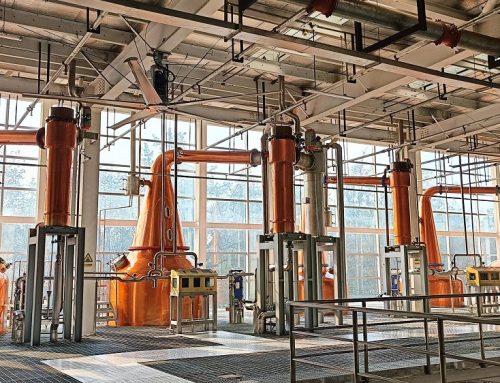
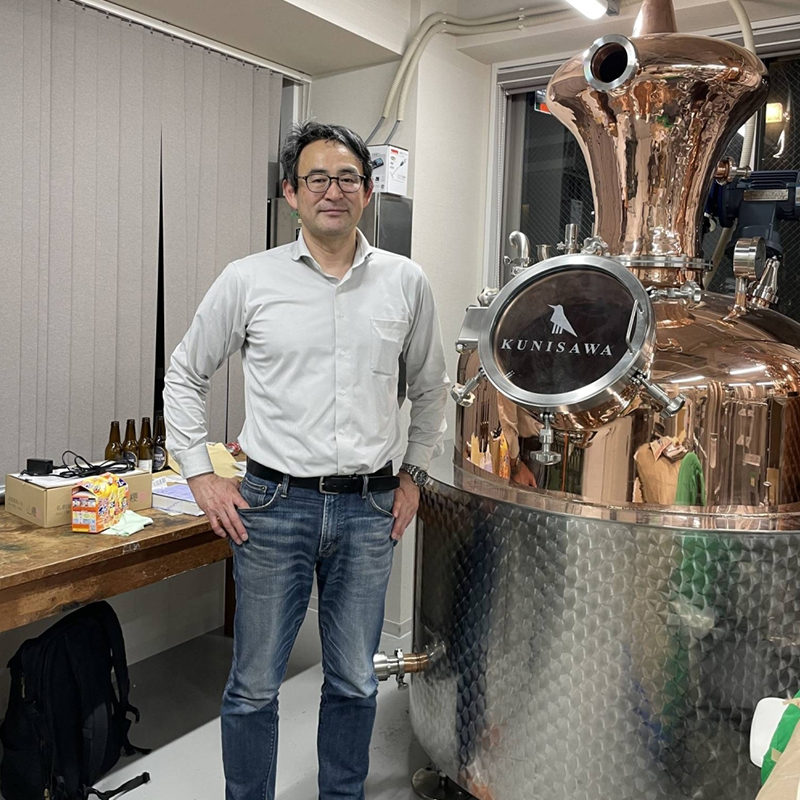
This is particularly important for craft distilleries because the still can become both a production asset and part of the visitor experience.
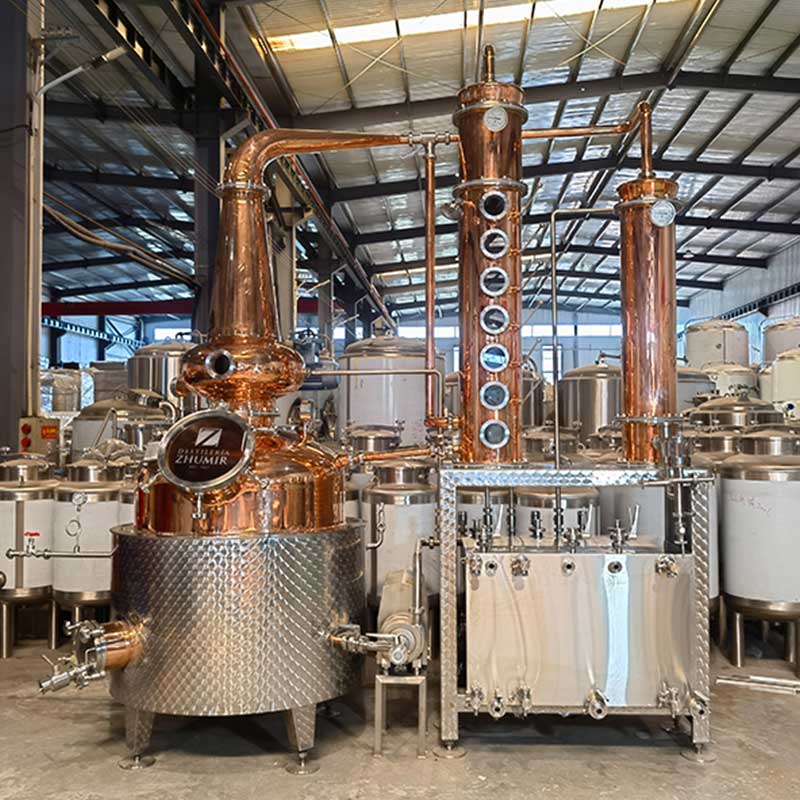
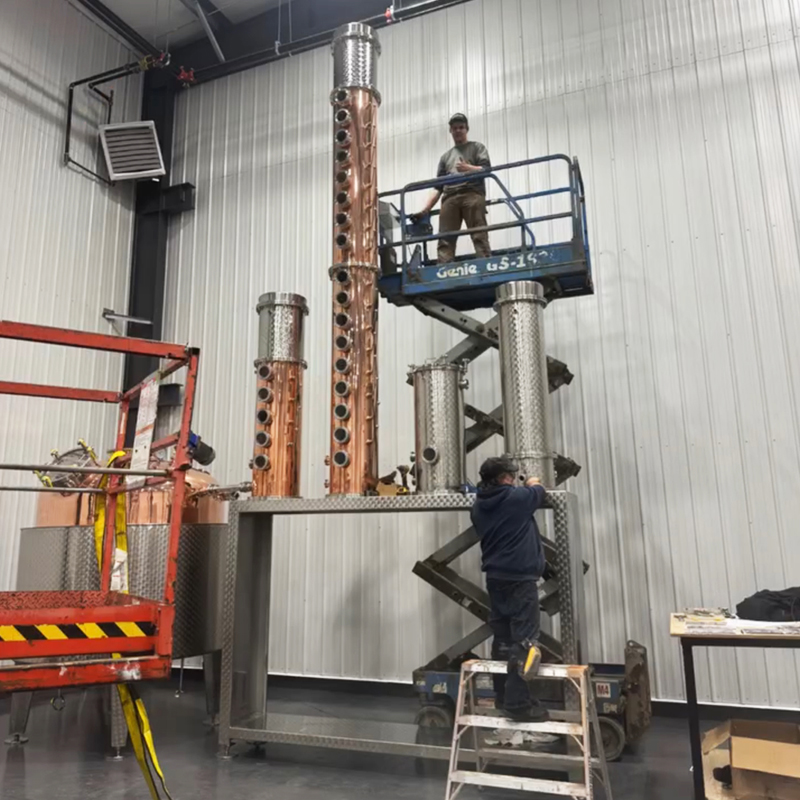
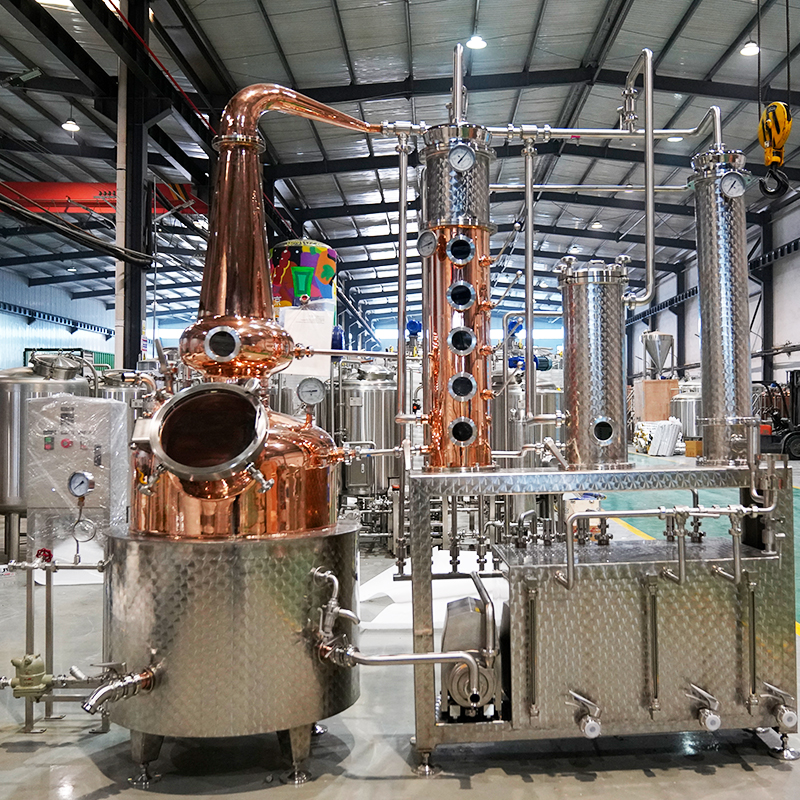
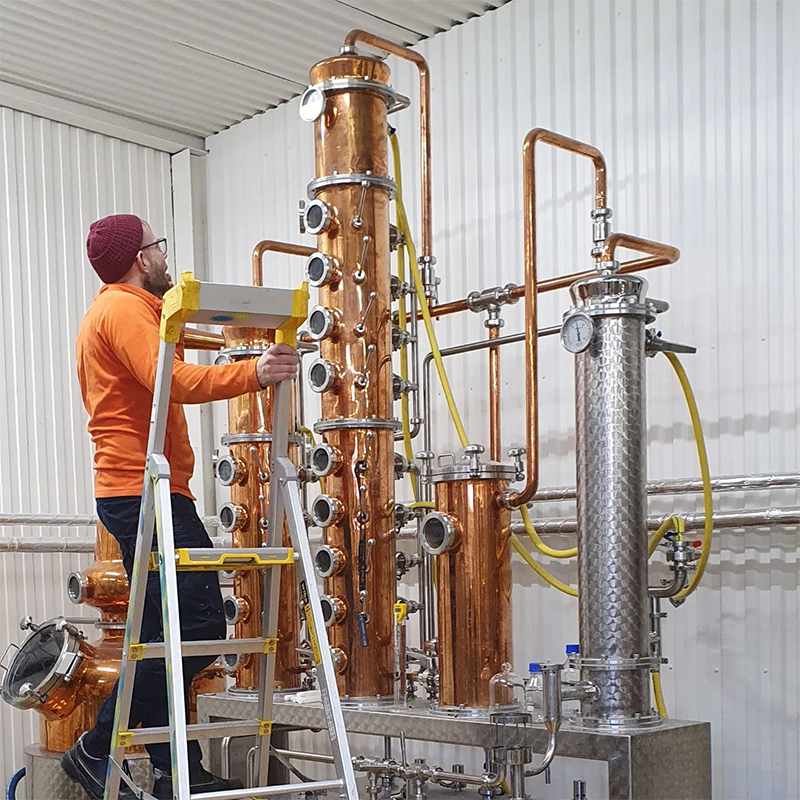
A pot still may be central to a traditional whiskey or brandy program. A column still may be more appropriate where high-purity alcohol and continuous production are priorities. A hybrid still can provide greater flexibility when a new distillery wants to produce multiple spirit styles without installing completely separate distillation systems.
The right choice depends on the production objective rather than the visual appearance of the equipment.
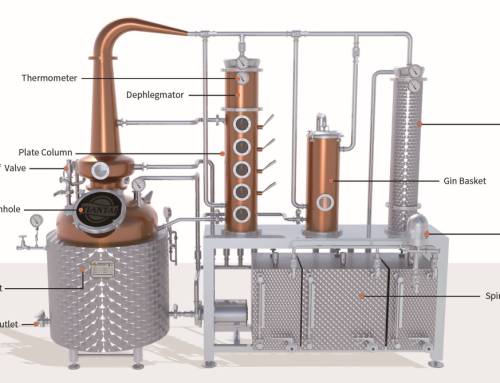
For example, Tiantai’s hybrid still systems can combine pot-still operation with additional column sections, doublers or thumpers, and gin baskets according to the intended spirit and process. This type of configuration can give a growing distillery more flexibility when its product portfolio evolves.
That flexibility can be especially valuable for startups.
A distillery may begin with one core product but later discover that customers respond strongly to another category. Equipment that can support controlled process changes is therefore often more useful than equipment optimized for only one narrow application.
Design equipment around the process, not the other way around
A common mistake in distillery construction is to choose a still first and build the rest of the plant around it.
A better approach is to work backward from the intended production process.
Different spirits may require very different process configurations.
A brandy plant may require fruit receiving, crushing, pressing, enzymatic treatment, fermentation, and copper distillation.
A vodka plant may put greater emphasis on grain preparation, fermentation efficiency, continuous distillation, and high-purity rectification.
A gin distillery may need botanical infusion or vapor-infusion capabilities in addition to a suitable base spirit system.
The equipment should reflect these differences.
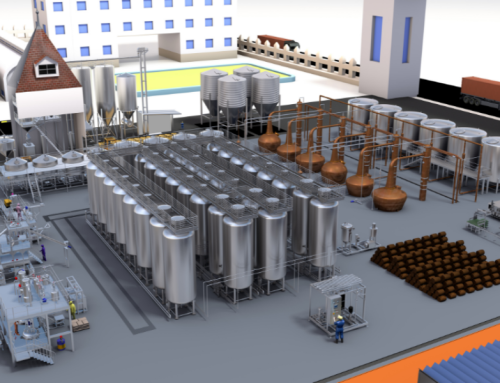
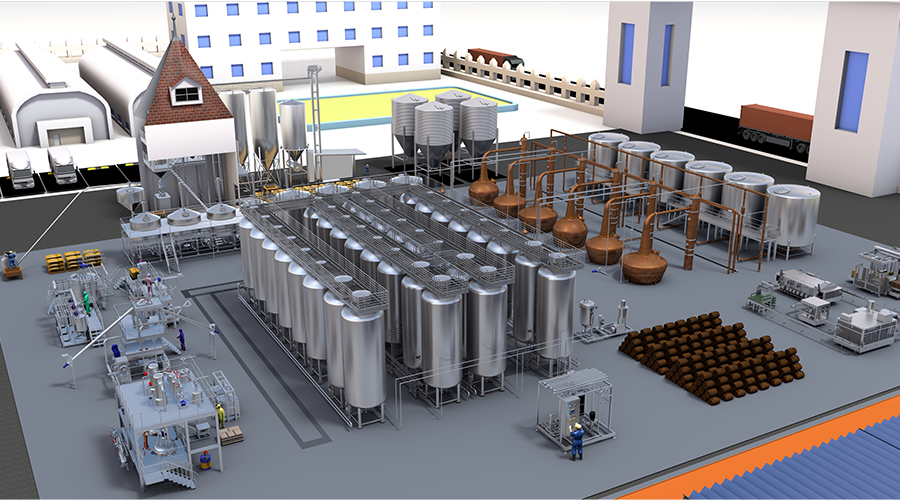
Tiantai approaches distillery projects as integrated production systems rather than isolated still purchases, covering process planning, P&ID and layout design, equipment manufacturing, installation, commissioning, and operator training.
That approach matters because the bottleneck in a commercial distillery is rarely just the still itself.
Fermentation capacity, raw material handling, heating, cooling, storage, maturation space, transfer systems, cleaning, utilities, and filling capacity all influence how efficiently the distillery can operate.
Think about the years when your whiskey is aging
Whiskey presents a special challenge for new distilleries.
The production process may start generating inventory long before that inventory becomes a mature commercial product. During that period, the distillery still has operating costs: labor, utilities, rent, maintenance, packaging development, sales, marketing, compliance, and equipment financing.
This is why product portfolio planning matters.
A whiskey-focused distillery does not necessarily need to abandon whiskey. Instead, it can consider whether part of its installed equipment can support products with shorter production cycles.
A flexible distillery may therefore use its fermentation and distillation infrastructure to produce different spirits while whiskey inventory continues to mature.
This is one reason hybrid and modular systems can be attractive to startup operators. They allow the distillery to develop its core identity around one product while retaining room for additional recipes, seasonal releases, or alternative revenue streams.
The original distiller discussion raised this issue repeatedly: a business built around a long-maturation product needs a realistic plan for the period before that inventory is ready for sale.
Packaging should reflect the production identity
Once the product has a real point of difference, packaging becomes much more powerful.
Bottle shape, label design, typography, closure, colors, and packaging materials should reinforce the same positioning communicated by the spirit itself.
A distillery built around traditional copper distillation, local agricultural production, and transparent process communication should not necessarily present itself like an anonymous luxury product disconnected from production.
Likewise, a modern distillery specializing in innovative botanical extraction or experimental maturation may benefit from a very different visual language.
The important principle is consistency.
The name, bottle, label, website, tasting room, social media, tour experience, and production story should communicate the same idea.
A distinctive bottle can win attention once.
A coherent product identity gives customers a reason to remember it.
Transparency can become a competitive asset
For many craft distilleries, one of the simplest ways to build trust is to explain what is actually being made.
A customer may not understand every technical term in a distillation process, but they can understand concrete information about ingredients, fermentation, distillation, maturation, and blending.
This also helps distinguish genuine production from vague marketing language.
The discussion that inspired this article included a strong recurring preference for process transparency: customers want to know what is in the bottle and how it got there, rather than being asked to rely entirely on generic descriptions.
For a distillery, transparency does not require revealing proprietary recipes.
A useful distinction is:
Explain the process without giving away the recipe.
You can describe the raw materials, production philosophy, still type, maturation approach, or general fermentation strategy while keeping exact formulations and operating parameters confidential.
That information can appear on the bottle, on an insert card, on the website, during tours, or through tasting-room staff.
The distillery itself can be part of the brand
For a craft producer, the physical distillery is not only a factory.
It can also be a place where customers learn about the product.
That makes equipment layout, visibility, cleanliness, workflow, safety, and visitor movement relevant to commercial strategy.
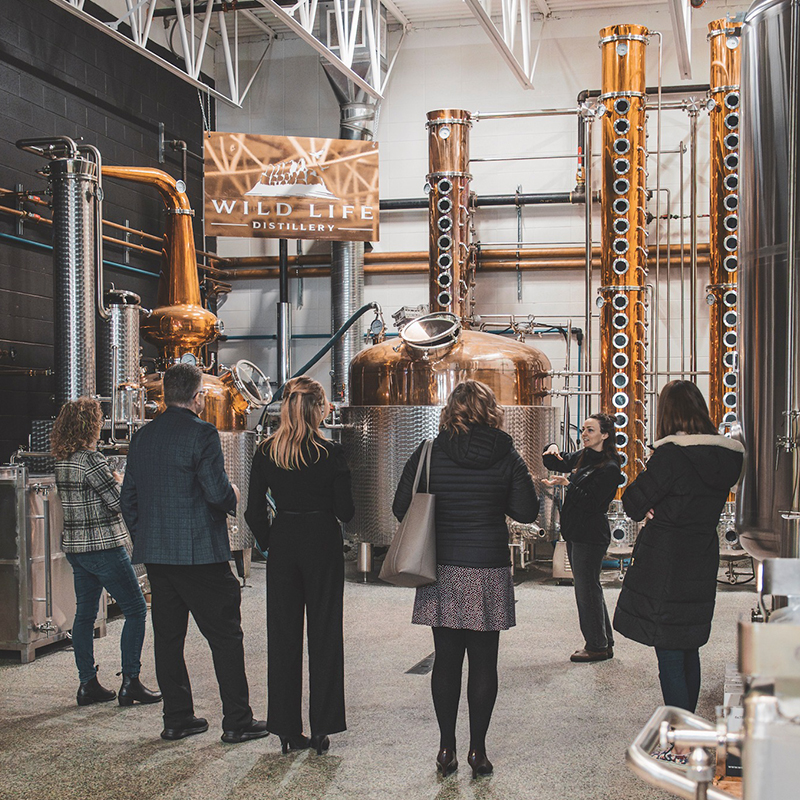
A well-planned visitor area can allow guests to see fermentation tanks, copper stills, processing equipment, barrel storage, or bottling operations without interfering with production.
This is another reason distillery design should consider both production and customer experience from the beginning.
The same stainless-steel tanks, copper stills, piping, and control systems that make the spirit can become part of the educational experience when the facility is designed accordingly.
A better way to plan a new distillery
Before purchasing equipment, a startup distillery can work through five questions:
1. Who is the customer?
Retail consumers, local visitors, cocktail bars, restaurants, distributors, online customers, or a combination?
2. What is the real product difference?
Raw materials, fermentation, distillation, maturation, botanical treatment, local sourcing, pricing, or something else?
3. What products support the business during different production cycles?
Especially important for spirits requiring extended maturation.
4. Which processes must the equipment support?
Milling, mashing, fermentation, pot distillation, rectification, botanical extraction, fruit processing, blending, proofing, filtration, bottling, and storage should all be considered as one production system.
5. How can the plant grow without becoming obsolete?
Future fermentation capacity, additional stills, larger storage, new spirit categories, automation, packaging upgrades, and utility expansion should be considered before the initial layout is finalized.
These questions often lead to a very different equipment plan than simply asking for the largest still that fits the available building.
Distillery equipment should support your differentiation
A distillery’s identity ultimately comes from what it makes and how it makes it.
Equipment enables that strategy.
A well-designed distillery system should provide the process control needed for consistent production while leaving enough flexibility for product development. Depending on the application, this may include grain mills, mash systems, fermenters, copper pot stills, hybrid stills, column stills, condensers, botanical systems, storage tanks, blending and proofing tanks, filtration systems, CIP equipment, and filling or packaging equipment.
Tiantai works with distilleries across whiskey, vodka, gin, brandy, rum, tequila, and other spirit applications, designing equipment around the required production process, capacity, layout, and expansion strategy. Its current distillery solutions cover projects from approximately 100 L to 8,000 L per batch, with customized process and equipment configurations rather than a single fixed plant design.
The goal should not be to buy the most complicated equipment.
The goal is to build a production system that makes the intended product repeatably, efficiently, and with enough flexibility to evolve as the business develops.
Final Thought
Standing out is often discussed as a branding problem.
For a new distillery, it is better treated as a systems problem.
A distinctive spirit starts with a clearly defined customer and market opportunity. That leads to a product concept. The product concept influences raw materials and process design. The process determines equipment requirements. The finished spirit then informs packaging, storytelling, customer experience, and sales channels.
When these pieces support one another, differentiation becomes much more than a label on a bottle.
The bottle can communicate the story.
The tasting room can demonstrate it.
The production process can prove it.
And the equipment can make it repeatable.
That is a much stronger foundation for building a distillery that customers remember — and a production system that can continue developing after the first bottle is sold.